
[Are you interested to pass the certification exam?
I am offering online training for ISTQB Agile Tester Extension Certification, both study and exam practice. Please contact me and we can talk more]
In SEP 2015, I took the ISTQB® Agile Tester Extension certification exam and gladly passed it. I searched on the internet if someone has shared his experience but there wasn’t any post that describes all the steps but I did receive helping comments to achieve this certification.
So I decided to write this post to put the points in one place so you can gain some understanding. I have tried to link to the material or reference that you can browse to get more details. (If you find something invalid or incorrect please don’t hesitate to contact me)
IMP: ISTQB® Agile Tester Extension is different than Certified Agile Tester (CAT) – iSQI – International Software Quality Institute GmbH
OBS! In this post, I have discussed below topics. This post might be long but puts everything in one place.
A. An overview of ISTQB® Agile Tester Extension
- What is ISTQB® Agile Tester Extension
- Entry criteria
- Objectives of Agile Tester Extension Syllabus
- Benefits of ISTQB® Agile Tester Extension
- Is Agile Tester Extension for you?
B. How to Prepare and Pass the exam
- Study material to prepare for exam
- How to book an exam
- Exam Structure
- Exam Tips
A. An overview of ISTQB® Agile Tester Extension
1. What is ISTQB® Agile Tester Extension?
An Agile “Extension” is defined by ISTQB® as a training and certification module with focus on topics as ;

- Domain-specific testing practices
- Specific Testing Techniques
- Specific Testing Methods
There is no continuation of the same certification but you can choose to have Advanced CTAL certifications.
2. Entry criteria
IMPORTANT: You need to have ISTQB® Foundation Certificate to be eligible to take the Agile Tester Foundation Extension certification exam. You are required to show the certificate to invigilator on exam day.
3. Objectives of ISTQB® Agile Tester Extension Syllabus
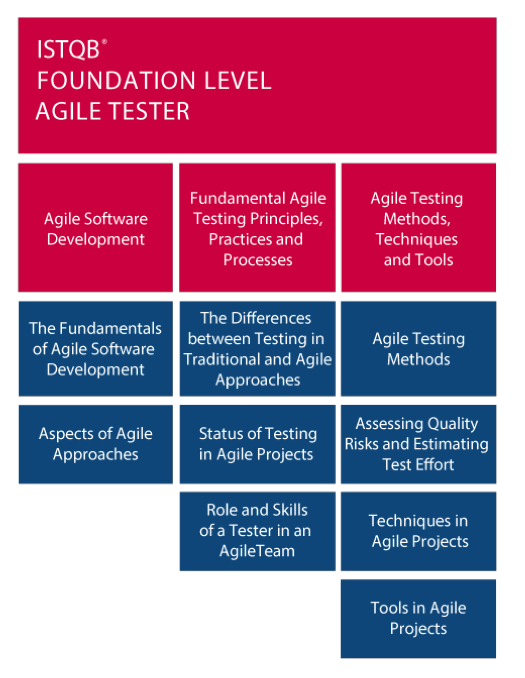
The syllabus of Agile Tester Extension is divided into three main parts or objectives;
- Agile Software Development: This part focuses on fundamentals of agile software development and aspects of agile approaches.
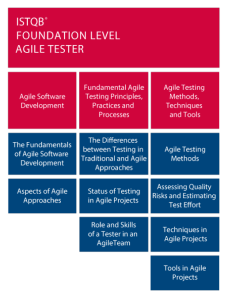
Agile Testing objectives - Fundamental Agile Testing Principles, Practices, and Processes: This part discusses more about agile way of working with respect to testing. It elaborates the differences between testing in traditional and Agile approaches, how to report the status of testing in agile projects and finally what is the role and skill of a testing which is important in an agile team.
- Agile Testing Methods, Techniques, and Tools: The last part is more interesting as it discusses the agile testing in detail with different aspects. It talks about agile testing methods, how to assess quality risks and estimating the test effort, test techniques which can be used in an agile project and finally the tools that can help in agile projects.
IMPORTANT: ISTQB® provides the Agile Tester Extension Syllabus to national examination bodies for them to accredit training providers and also to derive exam questions in local languages. Thus, it is important that you still understand and follow the syllabus as it is also used by training providers to prepare their own courseware.
4. Benefits of ISTQB® Agile Tester Extension
To work effectively in an Agile project and team, it is important for a tester to gain necessary skills to achieve this goal. The Agile Tester Extension helps to learn the fundamental agile testing principles, practices, and processes.
Besides following are the benefits which are explained by ISTQB® to build more understanding of its purpose.
- Collaborate with a cross-functional Agile team being familiar with principles and basic practices of Agile software development.
- Adapt existing testing experience and knowledge to Agile values and principles.
- Support the Agile team in planning test-related activities.
- Apply relevant methods and techniques for testing in an Agile project.
- Assist the Agile team in test automation activities.
- Assist business stakeholders in defining understandable and testable user stories, scenarios, requirements and acceptance criteria as appropriate.
- Work and share information with other team members using effective communication styles and channels.
5. Is ISTQB® Agile Tester Extension for you?
I have been working with Agile methodologies, especially in Scrum and Kanban for some time now. With this knowledge in hand, I was excited to go for Agile Tester certification.
Having both the working knowledge and certification is good in my opinion. This certification has been focused on professionals who are;
- Software testers experienced with traditional software development life cycles
- Entry level software testers who have an interest in agile testing
- Experienced software developers who have less or more knowledge of software testing in agile project
Even if you don’t plan to go for an exam, the study material will definitely improve your knowledge in terms of step by step and overall picture of testing in a project.
B. How to Prepare and Pass the exam
1. Study material to prepare for exam
Since this is relatively a new certification introduced in May/June 2014. There is no defined study material or books. But here is what I read to build more my Agile Testing concepts.
- Agile Tester Extension Syllabus Version:2014: Very important to read it 3-4 times. It will be a fruitful effort and return on investment of your time.
- Agile Testing: A Practical Guide for Testers and Agile Teams and More Agile Testing: Learning Journeys for the Whole Team. These two books are really useful. It discusses the details of Testing Quadrant and Testing pyramids. The role of Agile Tester and how quality can be introduced right from development. I highly recommend reading these two books to gain knowledge of Agile Testing even if you don’t want to go for the exam.
2. How to book the exam
You can either take the exam via your course training provider or book it separately from ISTQB associated bodies in your country. Since I took the exam in Sweden so I can explain the steps.
- Browse to Swedish Software Testing Board (SSTB) website
- You can select the language English or Swedish, but it went back to Swedish even though I selected English but don’t worry the information exists in both languages for each field.
- Select Agile Tester from Öppna SSTB-tentor/Open SSTB exams menu
- You are required to fill in information about your Foundation Level certificate ID, place & date, your personal information and personal number of passport number
- Once you have filled in and verified the date then you can proceed to payment and rest is very simple
- You should receive an email confirming your registration and location of exam
3. Exam Structure
The certification exam is based on multiple choice questions, If you are a non-native English speaker then you get total 75 minutes (60 mins + Bonus 15 mins).
There are total 40 multiple choice questions and to pass the exam you are required to score 65% or above (26 or more points). There is no negative marking and each correct answer scores one point.
Here is the distribution of the questions from each chapter. You can find the complete detail of exam structure here.
- Chapter 1: 13 questions
- Chapter 2: 12 questions
- Chapter 3: 15 questions
ISQTB has provided a sample exam paper and an answer sheet as well. You can go through them to understand the type of questions you can expect during the exam.
4. Exam Tips:
I can share my exam experience with you.
The sample exam paper is somehow similar but the questions in the exam were a bit tricky. There are my personal tips so you can adapt it accordingly…
- You “really need” to go through the syllabus 3-4 times and understand its content. Just reading or skimming won’t help because certain question requires good concepts and definitions in mind to answer.
- Go through and focus on the Learning Objectives (LOs) of each chapter to understand the concept and theory.
- Chapter 1 and 2 will help you to build understanding but you might need to put more effort to understand chapter 3 as It seems easy but in the exam, the questions became very tricky from this part.
- Following are the questions that I remember, fresh from memory.
- There were two questions on the agile manifesto, like which statement is not part of agile values. So in this case you need to memorize the statements, yes you need to.
- There was a question on Scrum, Kanban and XP practices, it asked which option is not part of XP practice. So you need to have an understanding for that to answer the question.
- There was a question about reporting the testing status, how it is being done.
- Benefits of early feedback and retrospective.
- Have a good understanding of Test Quadrants, there were two questions from it
- Have an understanding of Test Pyramid, how it helps to gain quality
- There were a couple of scenario based questions, ranging from selecting the valid test case to applying the correct testing approach or testing technique.
- Understand well the role of the tester in an agile team, there were 2-3 questions from this part as well.
- Be very careful with the time. It goes very fast. I had total 75 mins, so I planned to attempt 10 questions in every 15 mins. It helped me to stay on track and last 15 mins I spent on the question that I could not answer or verify If I wrote the same answer on my answer sheet.
- There are questions which have more text and will take time to read. The funny thing is all the answer look similar but be very careful, a few options look almost the same but a word might change it.
- Try to mark your answer on answer sheet directly, (if you prefer, I did that to save time) because during last minutes you won’t have much time or in a hurry, you might do something funny.
- A personal advice. When you come back home, don’t open the material and cross check the answer. I did it and felt I am doomed : )
Bonus Tip:
Once you have gone through the syllabus (3-4 times) and read other books to gain knowledge and build more understanding about Testing in Agile. To assess the exam preparation go through the Learning Objectives (LOs) of each chapter “again” and check if you have understand the concept of LOs. The exam questions are stated from LO perspective and the chapter content explains the theory behind that LO.
I am hopeful that if you follow this guide, you can prepare well and pass the exam. Good luck!
Let me know your comments.
(Images are taken from http://www.istqb.org)
 Towards Agility